Softmax and Cross-Entropy Backward Pass
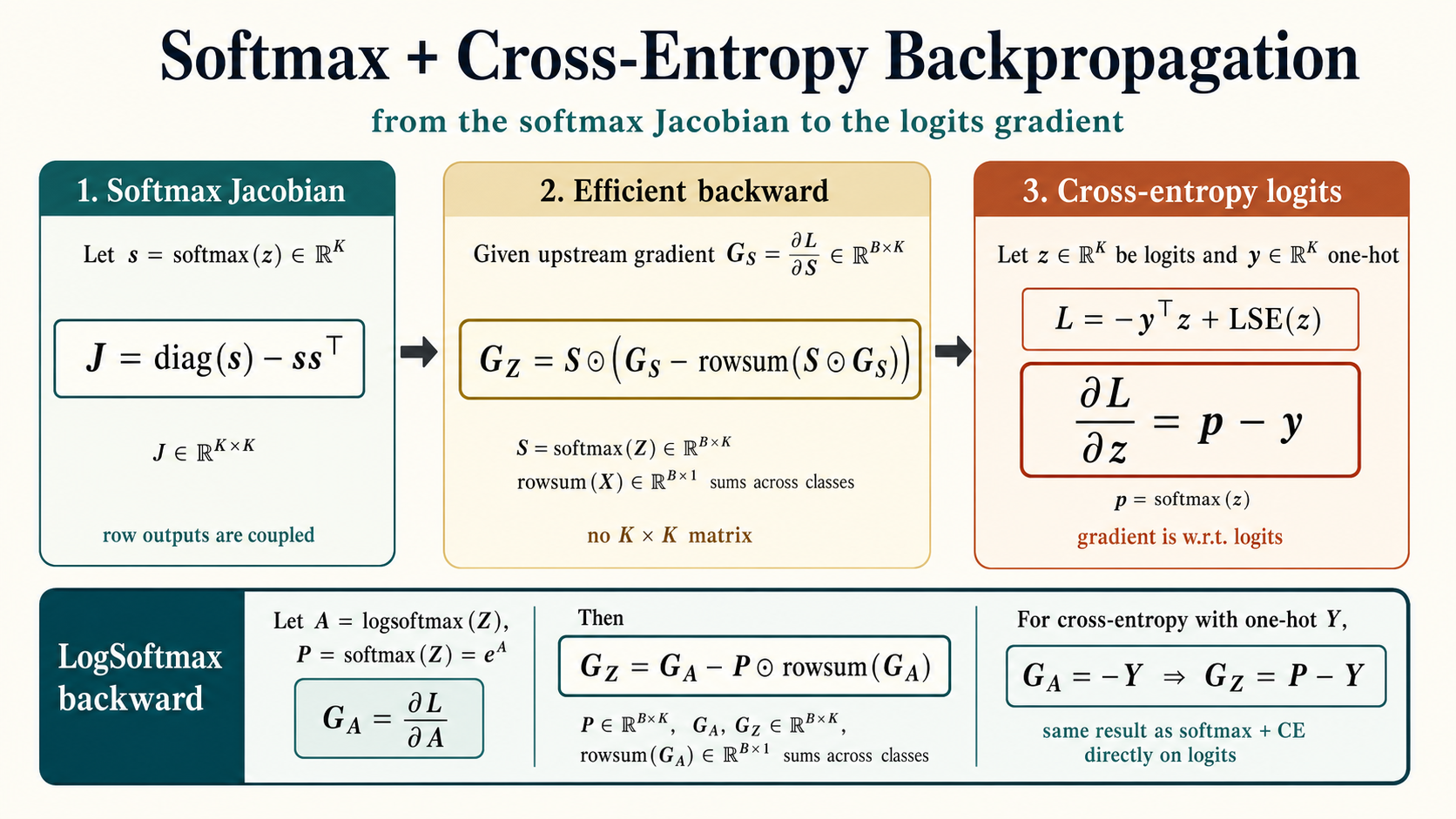
Softmax plus cross-entropy gets summarized so often as p - y that it is easy to forget where that expression comes from:
The formula is right, but two implementation details are easy to miss.
First, softmax is not elementwise. Every output probability depends on every logit in the same row because the classes share one normalization denominator. So the backward pass is a Jacobian-vector product, not a coordinate-wise derivative.
Second, \(p-y\) is a gradient with respect to logits, not probabilities. It shows up only after the log in cross-entropy interacts with the softmax Jacobian.
This note walks through both pieces: the general softmax backward pass for an arbitrary upstream gradient, and the cross-entropy/logsoftmax case that produces the expression used in training code.
Setup
For one row, let the logits be
\[z \in \mathbb{R}^K\]and define
\[s = \operatorname{softmax}(z), \qquad s_j = \frac{e^{z_j}}{\sum_{\ell=1}^{K} e^{z_\ell}}.\]For a batch, write the logits as
\[Z \in \mathbb{R}^{B \times K}\]and the softmax outputs as
\[S \in \mathbb{R}^{B \times K}.\]Softmax is applied row-wise:
\[S_{ij} = \frac{e^{Z_{ij}}}{\sum_{\ell=1}^{K} e^{Z_{i\ell}}}.\]Here \(i\) indexes the batch row. The indices \(j\) and \(k\) index classes, vocabulary entries, or whatever lives on the final axis. Rows do not interact, so it is enough to derive the formula for one row and apply it to the whole batch.
The Softmax Derivative
For one batch row \(i\), define the row-wise denominator
\[D_i = \sum_{\ell=1}^{K} e^{Z_{i\ell}}.\]Then
\[S_{ij} = \frac{e^{Z_{ij}}}{D_i}.\]We want the derivative
\[\frac{\partial S_{ij}}{\partial Z_{ik}},\]This asks a local question: if we nudge the logit for class \(k\), what happens to the softmax probability assigned to class \(j\)?
Using the quotient rule,
\[\frac{\partial S_{ij}}{\partial Z_{ik}} = \frac{ D_i \frac{\partial e^{Z_{ij}}}{\partial Z_{ik}} - e^{Z_{ij}} \frac{\partial D_i}{\partial Z_{ik}} }{ D_i^2 }.\]The numerator derivative depends on whether \(j=k\):
\[\frac{\partial e^{Z_{ij}}}{\partial Z_{ik}} = e^{Z_{ij}}\delta_{jk},\]where
\[\delta_{jk} = \begin{cases} 1, & j=k, \\ 0, & j \neq k. \end{cases}\]The denominator derivative is
\[\frac{\partial D_i}{\partial Z_{ik}} = \frac{\partial}{\partial Z_{ik}} \sum_{\ell=1}^{K} e^{Z_{i\ell}} = e^{Z_{ik}}.\]Substituting both pieces gives
\[\begin{aligned} \frac{\partial S_{ij}}{\partial Z_{ik}} &= \frac{D_i e^{Z_{ij}}\delta_{jk} - e^{Z_{ij}}e^{Z_{ik}}}{D_i^2} \\ &= \frac{e^{Z_{ij}}}{D_i}\delta_{jk} - \frac{e^{Z_{ij}}}{D_i}\frac{e^{Z_{ik}}}{D_i}. \end{aligned}\]Since
\[\frac{e^{Z_{ij}}}{D_i}=S_{ij}, \qquad \frac{e^{Z_{ik}}}{D_i}=S_{ik},\]we get the scalar softmax derivative:
\[\boxed{ \frac{\partial S_{ij}}{\partial Z_{ik}} = S_{ij}(\delta_{jk}-S_{ik}) }\]This compact expression contains both cases:
\[\frac{\partial S_{ij}}{\partial Z_{ij}} = S_{ij}(1-S_{ij})\]and, for \(j \neq k\),
\[\frac{\partial S_{ij}}{\partial Z_{ik}} = -S_{ij}S_{ik}.\]The sign tells the story. Increasing a logit’s own value increases its own probability. Increasing some other logit gives that other class more of the shared denominator, so this probability goes down.
The Jacobian
For a fixed row \(i\), collect all derivatives into a Jacobian matrix
\[J_i \in \mathbb{R}^{K \times K}, \qquad J_{i,jk} = \frac{\partial S_{ij}}{\partial Z_{ik}}.\]The diagonal entries are \(S_{ij}(1-S_{ij})\). The off-diagonal entries are \(-S_{ij}S_{ik}\). In matrix form:
\[\boxed{ J_i = \operatorname{diag}(S_i) - S_i S_i^\top }\]because
\[{\operatorname{diag}(S_i)}_{jk} = S_{ij}\delta_{jk}\]and
\[{(S_iS_i^\top)}_{jk}=S_{ij}S_{ik}.\]So each entry is
\[{(\operatorname{diag}(S_i)-S_iS_i^\top)}_{jk} = S_{ij}\delta_{jk}-S_{ij}S_{ik} = S_{ij}(\delta_{jk}-S_{ik}).\]This Jacobian is dense, but it is also highly structured. We definitely do not want to materialize a \(K \times K\) matrix for every row. For a language model vocabulary, \(K\) can be tens or hundreds of thousands. The backward pass needs the Jacobian-vector product, not the Jacobian itself.
There is a clean reason this Jacobian is symmetric. Define
\[\operatorname{LSE}(z) = \log \sum_{k=1}^{K} e^{z_k}.\]Its gradient is softmax:
\[\nabla_z \operatorname{LSE}(z) = \operatorname{softmax}(z).\]So the softmax Jacobian is the Hessian of logsumexp:
\[J_{\operatorname{softmax}}(z) = \nabla_z^2 \operatorname{LSE}(z).\]For a smooth scalar function, the Hessian is symmetric. That is why \(J_i^\top=J_i\) in this case.
Backpropagating Through Softmax
Let the upstream gradient for one row be
\[G_{S_i} = \frac{\partial L}{\partial S_i}.\]For a vector function \(y=f(x)\), the usual column-vector backpropagation rule is
\[g_x = J^\top g_y.\]For softmax, \(J_i\) is symmetric, so
\[G_{Z_i} = J_i^\top G_{S_i} = J_iG_{S_i}.\]Now expand the multiplication:
\[\begin{aligned} G_{Z_i} &= \left(\operatorname{diag}(S_i)-S_iS_i^\top\right)G_{S_i} \\ &= \operatorname{diag}(S_i)G_{S_i} - S_iS_i^\top G_{S_i}. \end{aligned}\]The first term is elementwise multiplication:
\[\operatorname{diag}(S_i)G_{S_i} = S_i \odot G_{S_i}.\]The second term has a scalar dot product inside:
\[S_iS_i^\top G_{S_i} = S_i(S_i^\top G_{S_i}).\]Therefore,
\[G_{Z_i} = S_i \odot G_{S_i} - S_i(S_i^\top G_{S_i}).\]Factoring out \(S_i\) coordinate-wise:
\[\boxed{ G_{Z_i} = S_i \odot \left(G_{S_i} - S_i^\top G_{S_i}\right) }\]Elementwise:
\[\boxed{ G_{Z,ij} = S_{ij} \left( G_{S,ij} - \sum_{k=1}^{K} S_{ik}G_{S,ik} \right) }\]This computes the same thing as the full Jacobian multiply, but the actual work is just a row-wise dot product and an elementwise multiply:
def softmax_backward(grad_out, softmax_out):
    dot = (softmax_out * grad_out).sum(dim=-1, keepdim=True)
    return softmax_out * (grad_out - dot)
Here grad_out is \(\partial L / \partial S\), and softmax_out is the saved softmax output \(S\) from the forward pass. The keepdim=True keeps the dot product shaped as \(B \times 1\) so it broadcasts across the class dimension.
As a quick sanity check, each row of \(G_Z\) sums to zero. That has to happen: adding the same constant to every logit in a row does not change softmax, so the backward pass should not push in that all-ones direction.
Cross-Entropy With Logits
Now let the target be \(y\). For a one-hot target, exactly one coordinate is \(1\). For label smoothing or soft targets, assume \(y\) is a normalized target distribution:
\[\sum_{j=1}^{K} y_j = 1.\]The cross-entropy loss for one example is
\[L = -\sum_{j=1}^{K} y_j \log p_j,\]where
\[p = \operatorname{softmax}(z).\]Since
\[\log p_j = \log \left(\frac{e^{z_j}}{\sum_{k=1}^{K} e^{z_k}}\right) = z_j - \log \sum_{k=1}^{K} e^{z_k},\]we can rewrite the loss directly as a function of logits:
\[\begin{aligned} L &= -\sum_{j=1}^{K} y_j \left( z_j - \log \sum_{k=1}^{K} e^{z_k} \right) \\ &= -\sum_{j=1}^{K} y_jz_j + \left(\sum_{j=1}^{K} y_j\right) \log \sum_{k=1}^{K} e^{z_k}. \end{aligned}\]Because \(\sum_j y_j=1\),
\[\boxed{ L = -y^\top z + \operatorname{LSE}(z) }\]Differentiate with respect to logit \(z_i\):
\[\frac{\partial}{\partial z_i}(-y^\top z) = -y_i\]and
\[\frac{\partial}{\partial z_i}\operatorname{LSE}(z) = \frac{e^{z_i}}{\sum_{k=1}^{K}e^{z_k}} = p_i.\]Therefore,
\[\boxed{ \frac{\partial L}{\partial z_i} = p_i-y_i }\]and in vector form,
\[\boxed{ \frac{\partial L}{\partial z} = p-y }\]For the target class \(t\), this is
\[\frac{\partial L}{\partial z_t} = p_t-1.\]For a non-target class \(i \neq t\), it is
\[\frac{\partial L}{\partial z_i} = p_i.\]In code, the plain batch-mean version looks like this:
probs = torch.softmax(logits, dim=-1)
B = logits.shape[0]
dlogits = probs.clone()
dlogits[torch.arange(B, device=logits.device), targets] -= 1
dlogits /= B
The final dlogits tensor is not a probability distribution. It is the gradient \(\partial L/\partial Z\). For a batch mean reduction with no class weights and no ignored labels,
The Same Result Through the Softmax Jacobian
The logsumexp derivation is the shortest route. It is still useful to check the same result by chaining cross-entropy through the softmax Jacobian.
Starting from
\[L = -\sum_{i=1}^{K} y_i \log p_i,\]the gradient with respect to probabilities is
\[g_p = \frac{\partial L}{\partial p} = -\frac{y}{p}\]elementwise.
The softmax backward formula from above is
\[g_z = p \odot \left(g_p - p^\top g_p\right).\]Compute the scalar dot product:
\[p^\top g_p = \sum_{i=1}^{K} p_i\left(-\frac{y_i}{p_i}\right) = -\sum_{i=1}^{K} y_i = -1.\]Then
\[\begin{aligned} g_z &= p \odot \left(-\frac{y}{p} + 1\right) \\ &= -y+p \\ &= \boxed{p-y}. \end{aligned}\]This is the cancellation people usually have in mind. The dense softmax Jacobian is still there mathematically, but the \(1/p_i\) term from differentiating the log collapses it into a simple logits gradient.
LogSoftmax Backward
In practice, frameworks usually avoid computing softmax probabilities and then taking a log. They use logsoftmax or a fused cross-entropy kernel, because logsumexp can be computed stably by subtracting the row maximum before exponentiating.
Define
\[a = \operatorname{logsoftmax}(z), \qquad a_j = \log p_j = z_j-\operatorname{LSE}(z).\]Differentiate:
\[\frac{\partial a_j}{\partial z_i} = \delta_{ji} - \frac{\partial \operatorname{LSE}(z)}{\partial z_i} = \delta_{ji}-p_i.\]Let
\[g_a = \frac{\partial L}{\partial a}.\]Then
\[\begin{aligned} g_{z_i} &= \sum_{j=1}^{K} g_{a_j} \frac{\partial a_j}{\partial z_i} \\ &= \sum_{j=1}^{K} g_{a_j}(\delta_{ji}-p_i) \\ &= g_{a_i} - p_i\sum_{j=1}^{K}g_{a_j}. \end{aligned}\]So the vector form is
\[\boxed{ g_z = g_a - p(\mathbf{1}^\top g_a) }\]and the batch form is
\[\boxed{ G_Z = G_A - P \odot \operatorname{rowsum}(G_A) }\]Here rowsum has shape \(B \times 1\) and broadcasts across the final axis.
In code:
def logsoftmax_backward(grad_out, softmax_out):
    rowsum = grad_out.sum(dim=-1, keepdim=True)
    return grad_out - softmax_out * rowsum
For negative log-likelihood or cross-entropy,
\[L = -\sum_{j=1}^{K}y_ja_j,\]so
\[g_a = -y.\]Because
\[\mathbf{1}^\top g_a = -\sum_j y_j = -1,\]substituting into the logsoftmax backward pass gives
\[g_z = -y - p(-1) = p-y.\]At that point, all three routes agree:
\[\boxed{ \text{cross-entropy with softmax logits backward} = \frac{\partial L}{\partial z} = \operatorname{softmax}(z)-y }\]and, for a plain batch mean,
\[\boxed{ \frac{\partial L}{\partial Z} = \frac{1}{B}(P-Y). }\]A Small Numerical Check
Suppose the predicted probabilities and one-hot target are
\[p = [0.659,\;0.242,\;0.099], \qquad y = [1,\;0,\;0].\]Then
\[\frac{\partial L}{\partial z} = p-y = [-0.341,\;0.242,\;0.099].\]The target-class gradient is negative. Under gradient descent,
\[z \leftarrow z - \eta \nabla_z L,\]subtracting a negative value increases the target logit. The non-target gradients are positive, so their logits decrease. That matches the training signal we expected.
What to Remember
Softmax backward is a structured Jacobian-vector product:
\[\boxed{ G_Z = S \odot \left(G_S - \operatorname{rowsum}(S \odot G_S)\right) }\]Cross-entropy with logits simplifies to:
\[\boxed{ G_Z = P - Y }\]with whatever scaling the loss reduction adds.
The mental model I use is this: softmax couples the classes through a shared denominator, and cross-entropy contributes the reciprocal probability term that removes that coupling in the logits gradient. That is why the training code can use a simple \(P-Y\) update even though softmax itself has a dense Jacobian.